Are you ready for a mind-bending truth about the future of AI?
What if the key to unlocking AI’s true power isn’t making it smarter, but embracing its flaws with better design?
The idea of “magical” AI—where you simply input a prompt and get a perfect result—is a fantasy. The reality is, AI “hallucinates,” confidently making up facts or sources. This is a feature, not a bug, inherent to LLMs, similar to how our subconscious human minds (System 1) generate a flood of random ideas. As Daniel Kahneman described in Thinking, Fast and Slow, our conscious mind (System 2) then evaluates and refines these ideas to find something useful. Don’t want to read? here’s a short video.
AI is our System 1, a tireless generator of output based on patterns, not truth. Its feedback loop rewards popularity, not accuracy or usefulness. This is where User Experience (UX) comes in. UX is the essential System 2, providing the human-centered framing that turns AI’s raw output into a valuable tool.
All great ideas
are built on iterating
lots of bad ideas.
The Role of UX in the AI Era
- Crafting the Input: UX research helps us understand human needs, allowing us to design interfaces that guide users to ask the right questions and provide the necessary context.
- Designing the Output: UX transforms raw, often overwhelming AI output into something usable and trustworthy by structuring information and building in clear feedback loops.
- Guiding the Interaction: A well-designed experience facilitates a conversation, giving users the tools to refine the AI’s suggestions and apply their own judgment.
Stop the cycle of re-prompting AI!
The most maddening frustration with AI? The endless cycle of re-prompting. When an approximation isn’t good enough, we tinker endlessly, asking it to fix one detail only to watch it ‘hallucinate’ or lose another from a previous version. This isn’t collaboration; it’s a tug-of-war. The solution lies in UX’s ability to reframe the output. Instead of viewing AI as a tool for creating a final product, we must design it to generate a customizable model. For example, when automating a complex process, a well-designed prompt can steer AI to produce a best-match template. With great UX and a snackable design for editing the result, you only need a few prompts to get “close,” and the user can then quickly and confidently refine the final details. This shifts the user’s role from a frustrated prompter to an efficient, powerful editor.
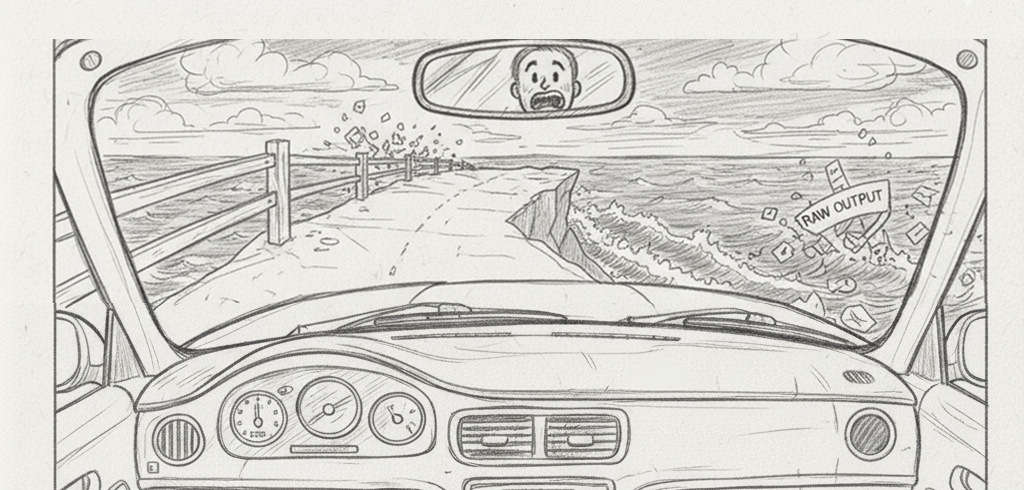
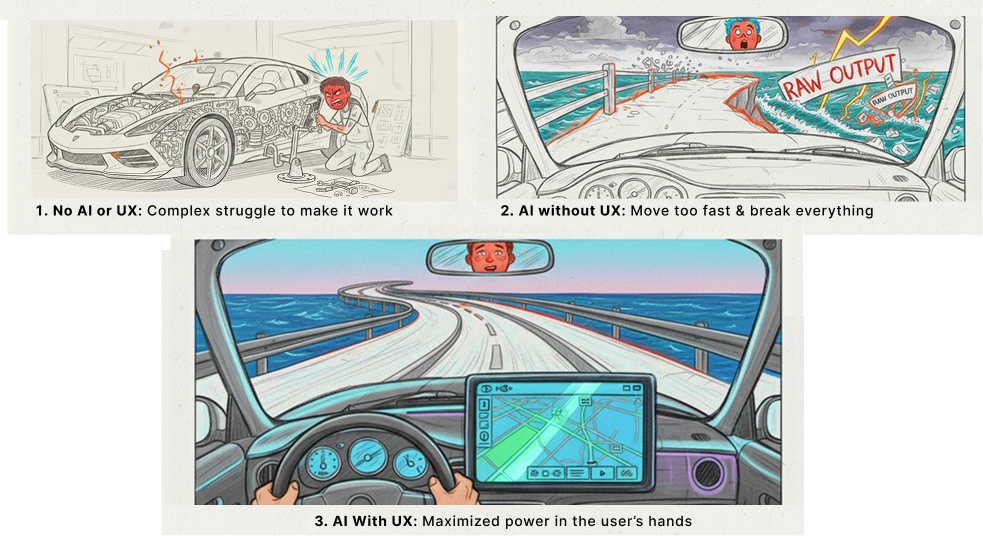
AI without UX is a powerful engine without a steering wheel.
 Our role as Product Designers is to provide the strategy and human judgment that transforms AI from a fascinating curiosity into an indispensable tool for success.
AI with UX puts
maximum power with purpose
in user’s hands

Two Small Asks
- For You: Reflect on a recent AI project. How did you ensure the user could apply their critical judgment to the AI’s output?
- Like, comment, share, disagree! Greatness requires iterative feedback. Add a comment, a like, a strong disagreement. If you enjoyed this article, share it with others!
Also published on Medium.